
When UGC Work Counts as Modeling Under New York Law
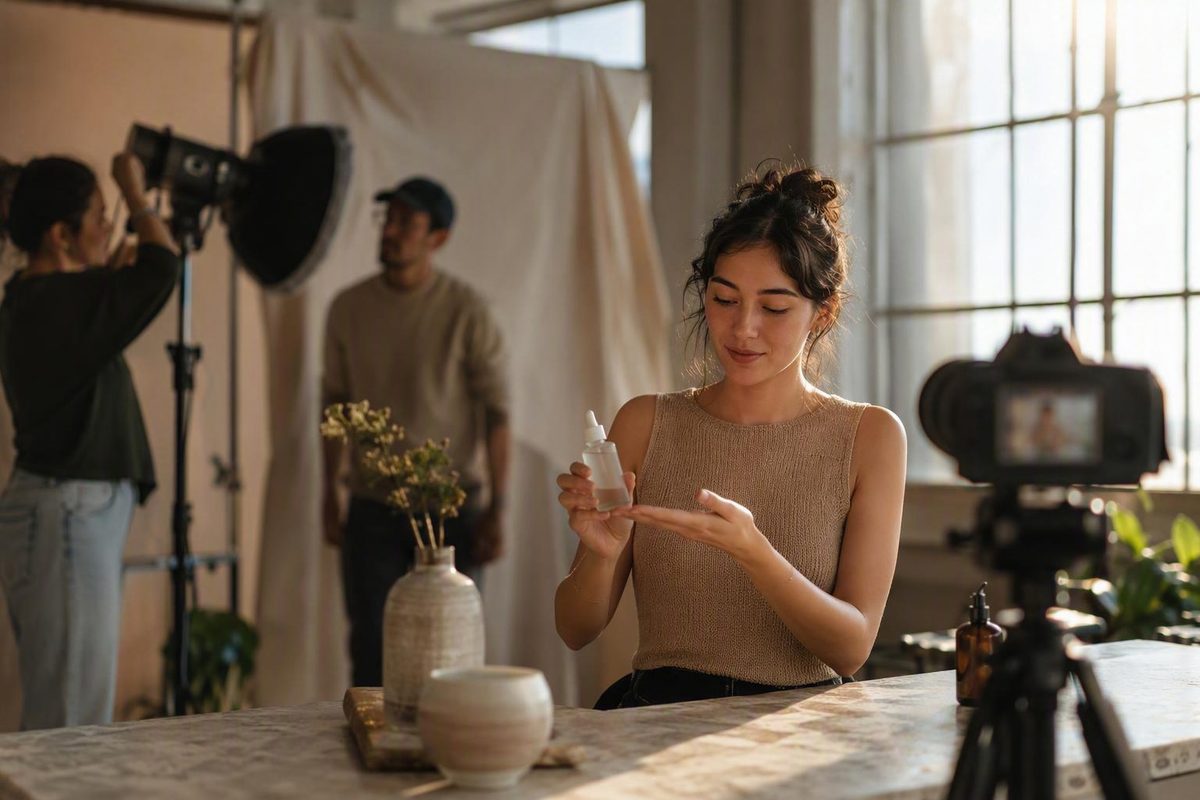
Coverage turns on the creator’s professional advertising appearance, who contracts for and manages it, intermediary roles, and the New York connection.
A UGC creator may be covered by New York’s Fashion Workers Act, but “UGC creator” is not itself a covered or excluded category. The practical test is whether the creator professionally appears, poses, performs, or represents a product or place for display or advertising; who contracts for and manages that performance; what any intermediary actually does; and how the engagement connects to New York. Production-only work—such as filming products, editing, writing, directing, or planning strategy without appearing as talent—is less likely to qualify.
The short answer: some UGC creators may be covered
New York’s definitions focus on services and business relationships, not the title on a brief or invoice. Calling someone a “UGC creator,” “influencer,” “content creator,” or “independent contractor” does not settle whether that person is acting as a model.
This explains an apparent conflict in commentary about the law. One legal-industry interpretation says influencers and content creators are not covered merely because they hold those roles. That is compatible with the narrower conclusion that a creator can qualify when performing modeling services. The National Law Review’s analysis of the Act frames the law as applying to people acting as models, rather than to creators or influencers as broad occupational categories.
Official guidance confirms that modeling services can include appearances on social media. A professional creator who appears in an advertisement may therefore be performing modeling services even if the parties call the deliverable “UGC.” The appearance must still satisfy the definition, and the roles of the client and any management company must also be considered.
The Act took effect on June 19, 2025. Separately, reporting states that the one-year registration period for model management companies ended on June 19, 2026. That deadline concerns company registration, not the classification of an individual creator or campaign. Registration status can be a compliance indicator, but it does not prove that a particular engagement is covered or excluded, as explained in The Fashion Law’s registration update.
This guide provides general information, not an engagement-specific legal determination. A qualified New York employment or entertainment lawyer may need to review the contract, working arrangements, and location facts when coverage is disputed or several states are involved.
Use the activity test, not the creator’s job title
A model is a person who performs modeling services as part of their trade, occupation, or profession. The person can be an employee or an independent contractor.
Modeling services include photographic sessions and live, filmed, or taped appearances, including appearances on social media. Relevant activities include:
- posing;
- providing an example or standard of artistic expression; or
- representing something or someplace for display or advertising.
Those definitions are broad enough to reach some familiar UGC deliverables, such as an on-camera product demonstration, a scripted testimonial, a sponsored beauty routine, or a creator posing with an item for paid social advertising. But a social-media appearance is not automatically covered. It must satisfy the rest of the definition and form part of the creator’s trade, occupation, or profession. The client, any intermediary, and the New York connection must also be assessed under the Department of Labor’s Fashion Workers Act definitions.
Use this decision path:
- Does the creator personally appear or perform? An appearance involving the creator’s face or body, posing, or an on-camera performance is more relevant than merely supplying a finished asset. The supplied guidance does not establish that ordinary voice-only work independently qualifies as modeling services.
- Is the appearance for display or advertising? A paid brand promotion is a stronger fit than production work unrelated to an appearance.
- Is the work part of the creator’s trade, occupation, or profession? A professional content practice fits the definition more readily than an incidental personal post.
- Does a qualifying client contract for and manage the services? Look beyond the signature block to scripts, shot lists, instructions, approvals, performance direction, and reshoot rights.
By contrast, filming a product without appearing, editing footage, writing scripts, directing other talent, or planning content strategy is less likely to constitute modeling services on its own. Those are creative or production services, but their commercial purpose does not automatically turn them into modeling.
Hybrid engagements should be divided by deliverable. One statement of work can contain both modeling and non-modeling services.
Four UGC scenarios compared
These comparisons are indicators, not automatic classifications.
| Scenario | Facts supporting coverage | Unresolved facts | Cautious assessment |
|---|---|---|---|
| Agency books a professional creator for a New York fashion campaign | The creator appears on camera, promotes a product professionally, is booked through an intermediary, and performs the work in New York | Whether each business meets the relevant definition and which entity manages the performance | Stronger case for coverage |
| Creator contracts directly with a brand for a demonstration or testimonial | The creator poses, demonstrates the product, or delivers an on-camera advertisement | Whether the brand contracts for and manages the performance, and whether the engagement has a sufficient New York connection | Potentially covered |
| Creator scripts, shoots, edits, and appears in the asset | The creator personally performs in advertising | Which deliverables and fees relate to the appearance rather than filming, editing, or licensing | Mixed engagement; assess each service separately |
| Creator supplies footage, copy, editing, direction, or strategy without appearing | The work has a commercial purpose | Whether any separate appearance or performance is required | Less likely to qualify as modeling |
A remote, self-directed testimonial sits between the second and third scenarios. The creator’s appearance in advertising supports possible coverage. But if the brand gives little direction and accepts only a finished file, it may be unclear whether the brand manages the performance as required by the client definition. The supplied guidance does not establish a minimum amount of direction, so independent production should not be treated as automatically covered or excluded.
The same caution applies when a creator is paid for a package rather than itemized services. A single fee may cover production, performance, revisions, and usage rights.
Map the brand, agency, and intermediary separately
A client is a person, business, or organization that contracts for modeling services and manages their performance. The client can do so directly or through a model management company or another intermediary. Placing an advertising agency, production company, creator agency, or other go-between in the chain does not necessarily prevent the commissioning brand from being a client.
Do not assume that every entity involved in booking or payment has the same legal role. Ask who:
- commissioned the creator’s appearance;
- selected or approved the talent;
- supplied performance instructions;
- controlled scripts, shot lists, wardrobe, claims, or settings;
- approved takes or required reshoots;
- negotiated the appearance and usage terms; and
- collected or paid the relevant fees.
A model management company can include an entity that manages models’ participation in performances, secures modeling engagements for a fee, or provides paid guidance about working in modeling. The company’s actual services and fee structure matter more than whether it calls itself a creator, talent, influencer, social-media, or creative agency.
The Department of Labor provides a particularly relevant example: a social-media agency may qualify when it represents a brand and hires or connects that brand with a model or influencer to promote a product on social media. The Department’s Fashion Workers Act FAQ also says covered model management companies must act honestly and in the model’s best interest and may not charge commissions exceeding 20% of the model’s compensation.
That example does not turn every platform or agency into a model management company. An editing studio, software marketplace, referral service, or campaign consultancy may perform different functions. Map whether the intermediary sources talent, negotiates engagements, books work, manages performances, takes a fee, collects commissions, or provides career guidance.
Older discussions sometimes referred more broadly to “creative” management. That language should not be used to expand the enacted law automatically. Classification should follow the final definitions and current official guidance, not descriptions drawn from earlier versions of the legislation.
Check the engagement’s New York connection
Work performed in New York presents the clearest jurisdictional case. Harder questions arise when the creator films at home in another state, the brand is based in New York, the agency operates elsewhere, or production is split across several locations.
A law-firm interpretation identifies two potential grounds for application: services performed in New York or a contract governed by New York law. It also cautions against assuming that a client’s New York location alone triggers the Act when the work occurs elsewhere, as discussed in Loeb & Loeb’s guidance for brands and agencies.
The Act’s protections apply when the contract is governed by New York law New York’s Fashion Workers Act: What Brands and Ad Agencies Need to Know | Loeb & Loeb LLP. Before assessing coverage, record:
- where the creator was physically located during production;
- where any studio or shoot was located;
- where the contracted appearance or performance occurred;
- where the client is located;
- where each intermediary operates; and
- which state’s law the contract says will govern.
Do not rely on one fact in isolation. A New York brand, payment address, agency office, or governing-law clause may be relevant without deciding a mixed-location dispute. Entirely out-of-state and multi-state engagements warrant fact-specific legal review.
What may change if the creator is covered
First establish that the creator performs covered modeling services and that the brand, agency, or other participants meet the relevant definitions. Only then should the parties assign particular obligations.
For a qualifying model management company, potential duties include acting honestly and in the model’s best interest, supplying required agreements or deal documentation, explaining deductions, and limiting commissions to 20% of the model’s compensation. Those obligations attach to a qualifying management company, not automatically to every creator agency or production vendor.
Potential client obligations include paying 1.5 times the contracted hourly rate for work exceeding eight hours in a 24-hour period and providing a 30-minute meal break when an engagement exceeds eight hours. Clients may also have obligations concerning working conditions, a model’s representation on set, and liability insurance. Which business is responsible depends on its role in the arrangement, according to the legal analysis of client obligations under the Act.
A self-shot two-hour video will not raise the same operational questions as a ten-hour studio production, even if both involve covered modeling services. That does not make the shorter engagement categorically exempt; it means time-based requirements may not be triggered in the same way.
Digital replicas require a separate contract review. For covered models, clients and model management companies must obtain the separate, explicit written consent applicable to their proposed creation or use of a digital replica. The consent should specify the scope, purpose, duration, and compensation. Broad language granting perpetual rights to a creator’s likeness “in all media” should not be treated as a substitute for the required digital-replica permission, according to Davis+Gilbert’s analysis.
This issue can arise when a brand proposes to clone a creator’s voice, generate new footage from the creator’s appearance, substantially replace a performance, or produce synthetic variations without another shoot. Those permissions should be separated from routine editing, minor retouching, and ordinary usage rights.
A contract audit creators and brands can use
Before deciding whether the Act may apply, audit the work rather than the job title.
- Mark every appearance deliverable. Identify each photo or video requiring the creator to appear, pose, perform, demonstrate, or represent a product or place for advertising.
- Separate production from performance. List scripting, filming, editing, direction, strategy, and asset delivery separately from the creator’s on-camera work.
- Record who controls the performance. Preserve scripts, shot lists, visual references, wardrobe requirements, talking points, approvals, revision requests, and reshoot demands.
- Map each intermediary. Note who sources creators, negotiates terms, books work, manages performances, collects payments, takes a fee or commission, and provides career guidance.
- Break down compensation. Where the commercial structure allows it, separate production fees, performance fees, licensing, expenses, commissions, overtime, revisions, and reshoots.
- Check location and governing law. Record where the work occurred and read the governing-law clause without assuming either fact guarantees the result.
- Audit synthetic-media language. Search for “likeness,” “synthetic media,” “AI,” “voice cloning,” “digital replica,” “alteration,” “training,” and “reuse.” Flag any attempt to bury digital-replica permission inside general usage rights.
- Check registration where relevant. If an intermediary may be operating as a model management company, consult New York’s public registry. Presence or absence in the registry is a compliance clue, not conclusive proof that the creator or engagement is covered.
- Preserve the working record. Keep the brief, statement of work, contract, deal memo, revisions, time records, payment records, agency deductions, approvals, and messages showing who directed the performance.
The practical rule is not to ask only whether the worker is called a UGC creator. Ask whether the creator personally performs in advertising, who contracts for and manages that performance, what each intermediary actually does, and how the engagement connects to New York. If those facts point toward modeling services, audit the compensation, commission, working-condition, and digital-replica terms, then obtain qualified legal advice for the specific deal.
Can a UGC creator be covered when contracting directly with a brand?
Potentially. Traditional model-agency representation is not necessarily required because a client can contract for and manage modeling services directly. A creator may qualify if the work is professional modeling activity, the brand contracts for and manages the performance, and the engagement has the necessary New York connection under the Department of Labor’s Fashion Workers Act FAQ.
Management of the performance is the uncertain point in some direct deals. Scripts, shot lists, mandatory talking points, approval rights, detailed instructions, and required reshoots may help identify the brand’s role. A self-directed creator who supplies only a finished file with minimal brand input presents a more fact-sensitive case.
Does creating UGC from home prevent Fashion Workers Act coverage?
No, not automatically. A home-shot social-media appearance can still involve posing, performing, demonstrating, or representing a product for advertising. Working from home does not by itself change the nature of the appearance under the Department of Labor’s definitions.
Location still matters to the jurisdictional analysis. A creator filming at home in New York presents a clearer connection than one filming entirely in another state. For remote out-of-state work, review the place of performance, client and intermediary locations, governing-law clause, and who manages the performance.
Does independent-contractor status exclude a creator from the Act?
No. The model definition can include both employees and independent contractors. The relevant question is whether the creator performs modeling services as part of their trade, occupation, or profession—not which tax or contract label the parties selected, as summarized in Morgan Lewis’s analysis of the enacted Act.
Independent-contractor status does not establish coverage either. The creator must still perform qualifying services, the other parties must meet the relevant definitions, and the engagement must have the required connection to New York.