
What This Hybrid Video Role Actually Involves
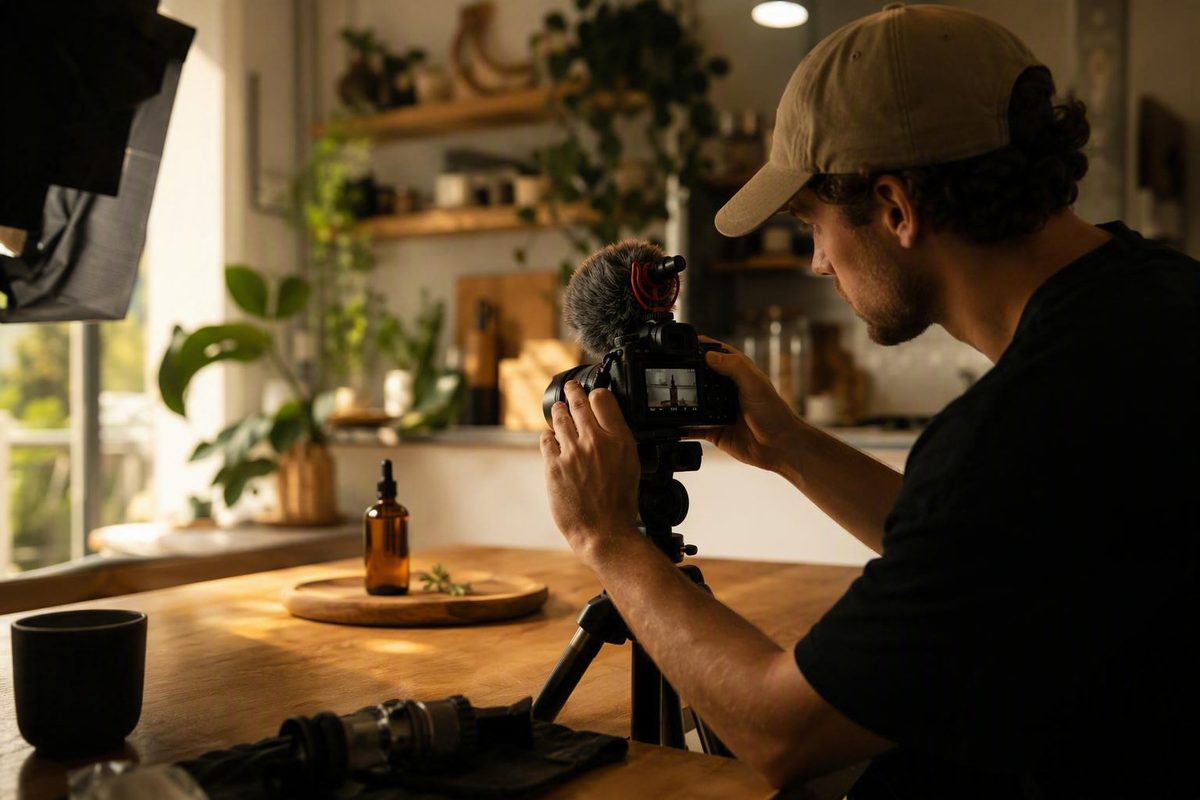
Learn how the role can cover concepts, filming, editing and platform-ready assets, plus essential skills, workflow, freelance scope and related pay data.
A videographer content creator combines hands-on video production with broader content work. They may plan a concept, record and edit footage, adapt it for different platforms, and deliver finished assets. Clients and aspiring professionals should define the scope instead of relying on the title alone.
What is a videographer content creator?
A videographer content creator combines videography responsibilities with some degree of content planning, adaptation, or delivery. The videography side centers on recording usable pictures and sound. The content-creation side may extend to shaping the idea, presenting information for a particular audience, or turning one shoot into several platform-ready assets.
It is better understood as a practical description assembled from related roles such as videographer, camera operator, and video editor.
Videographers may film private events, produce corporate documentaries, and edit their own footage. Related production duties can include selecting lenses and lighting, collaborating with directors, organizing digital footage, and assembling scenes in post-production, according to the BLS overview of film and video editors and camera operators.
Some hybrid creators develop concepts and scripts; others receive a finished brief and concentrate on production. Strategy, publishing, analytics, and community management are possible additions, not automatic responsibilities. A contract or job description should identify who handles each stage.
Videographer vs content creator, camera operator, and video editor
These roles overlap, but their primary focus differs:
| Role | Primary focus | Typical responsibilities | Where it may overlap |
|---|---|---|---|
| Videographer | Producing recorded video | Preparing shoots, capturing footage and audio, making visual choices, and commonly editing the material | May plan concepts, direct subjects, edit, and deliver social versions |
| Camera operator | Recording footage during production | Operating cameras, selecting or changing lenses, supporting lighting choices, and collaborating with a director or production team | May contribute technical and visual ideas without owning the finished content |
| Video editor | Building the finished piece in post-production | Organizing files, selecting takes, assembling scenes, refining pacing, and preparing exports | May add captions, sound, graphics, or platform-specific versions |
| Content creator | Making audience-facing content | Potentially developing ideas, scripting, recording, editing, formatting, publishing, and responding to audience needs | May perform the full video workflow or outsource specialist tasks |
An editor may begin only after the footage has been captured.
A hybrid professional can absorb several of these functions. That breadth can suit compact projects with a clear creative direction, but it can also create unrealistic expectations if “content creation” is interpreted as unlimited strategy, production, editing, design, publishing, and channel management.
Clients should assess deliverables and relevant work samples rather than assume a broad title confirms every capability. Creators should likewise distinguish their core services from optional additions.
An end-to-end video content workflow
There is no universal workflow for every event, corporate film, product video, or social campaign. The following is a practical example of the stages one hybrid creator might handle:
- Clarify the brief. Identify the audience, message, deliverables, formats, deadline, approval process, and intended use.
- Plan the concept and shots. Develop the structure, script or talking points, shot list, locations, and production schedule.
- Capture footage and audio. Record the main presentation, demonstrations, interviews, supporting footage, and usable sound.
- Organize the files. Back up and label footage, audio, graphics, and other assets before editing.
- Build the main edit. Select takes, establish the sequence, remove unnecessary material, and refine the pace.
- Add finishing elements. Apply agreed captions, graphics, music, sound adjustments, or simple animation.
- Repurpose the material. Create shorter cuts, change the framing or aspect ratio, and adjust openings or calls to action for different placements.
- Export and review. Produce review files, collect consolidated feedback, and complete the agreed revisions.
- Deliver or publish. Supply the specified formats and files, or publish them if channel management is expressly included.
For example, a product demonstration might begin with a concise explanation and a list of close-up shots. During production, the creator records a presenter using the product and captures supporting details. In post-production, they build one main demonstration and extract shorter vertical clips with quicker openings and captions.
The resulting package could contain a landscape master, vertical social edits, thumbnails, and caption files. Those assets are not inherent in the job title, however; they must be included in the agreed scope.
Editing platforms can support many individual stages. Adobe documents workflows for webcam recording, trimming, cropping, resizing, captioning, merging, audio extraction, social clip creation, animation, and conversion to MP4 or GIF in its Adobe Express video documentation. The presence of those documented features does not establish availability on every plan or in every region, nor does it demonstrate production quality or suitability for every professional project.
Tools can accelerate routine transformations, but they do not determine which moment carries the story, whether the sound is distracting, or whether an edit serves the intended audience.
Skills the role brings together
A capable videographer content creator combines four groups of skills.
Capture skills include operating a camera, judging framing and movement, choosing lenses, working with available or added light, and recording intelligible audio. The methods depend on the assignment: an interview, live event, product close-up, and handheld social video each present different constraints.
Hand-eye coordination can matter when following action or adjusting equipment while recording. Physical stamina can also be relevant because location work may involve prolonged standing, travel between spaces, repeated setups, and carrying production equipment. The BLS identifies hand-eye coordination, physical stamina, creativity, communication, attention to detail, computer ability, and visual skills among the important qualities for related occupations and describes the associated work environments and physical demands.
Post-production skills include organizing footage, managing versions, using editing software, selecting strong takes, controlling pace, and preparing the correct output. Depending on the assignment, the creator may also handle captions, basic graphics, audio adjustments, reframing, and short-form cutdowns.
Storytelling skills include identifying the point of the video, creating a logical sequence, maintaining attention, and making visual choices appropriate to the audience. Creativity and visual judgment help turn technically acceptable footage into coherent communication. Attention to detail helps catch continuity problems, awkward cuts, inaccurate captions, and unwanted elements in the frame.
Collaboration skills include asking useful questions, translating a brief into production decisions, directing contributors respectfully, communicating constraints, and managing feedback. A hybrid creator often connects a client’s objective with the practical realities of producing the video.
Software competence is only one layer. Knowing where to find a trimming or caption tool does not establish an ability to direct a nervous interview subject, recognize weak lighting, structure a persuasive demonstration, or keep a project within scope. Those abilities develop through production practice, review, communication, and judgment.
Freelance scope and business responsibilities
Many videographers work on a freelance or self-employed basis. Their work can therefore include business administration as well as creative production, such as preparing bids, managing contracts, securing permissions, addressing copyright questions, and maintaining financial records, as described by the BLS occupational profile.
Before accepting a project, both parties should resolve questions such as:
- What final videos, cutdowns, caption files, thumbnails, or other assets are included?
- How much planning and shoot time does the price cover?
- Where will filming occur, and who secures access or location permission?
- What editing and finishing work is included?
- How many revision rounds are allowed, and what counts as a revision?
- Are travel time and travel expenses included?
- What are the shoot, review, revision, and delivery deadlines?
- Will raw footage or editable project files be delivered?
- Who is responsible for uploading, scheduling, or publishing?
- Where, how, and for how long may the finished content be used?
- Is the content intended for organic publishing, paid promotion, internal use, or another purpose?
- Are exclusivity or category restrictions being requested?
This is a scoping checklist, not a universal set of contract clauses or pricing rules. A short organic social post and a paid advertising asset may have different review, delivery, and usage requirements. Similarly, handing over a final export is not necessarily the same deliverable as transferring raw footage and editable project files.
Review the complete contract and consult an appropriate professional before accepting provisions involving usage rights, copyright transfer, or exclusivity; this is also the limited contract guidance given in Larping Agency’s terms notice.
Education, earnings, and working conditions
The BLS identifies a related bachelor’s degree—such as one in film, broadcasting, arts, or communications—as typical entry-level education for its camera-operator and film-and-video-editor categories. That is not a legal requirement or a universal rule for every freelance videographer content creator. Hiring criteria can vary by employer, specialty, and project.
In May 2025, U.S. median annual pay was $74,990 for television, video, and film camera operators and $75,420 for film and video editors. The combined median was $75,100, but that figure covers two BLS occupational groups. It is not a freelance day rate, a per-video price, an entry-level expectation, or a guaranteed salary for someone using the content-creator title.
Self-employed workers represented 35% of each occupational category in 2025. The BLS projected 3% U.S. employment growth from 2025 to 2035, equal to about 1,900 additional jobs, along with an average of 5,600 openings per year. Many of those openings were expected to result from replacing workers who leave the occupations. These figures apply to the covered U.S. occupational groups, not every creator specialty, freelance market, or local region, as detailed in the BLS education, pay, and outlook data.
Day-to-day conditions can be demanding. Location production may involve travel, irregular schedules, prolonged standing, carrying equipment, and repeated setups. Freelancers must also make time for proposals, scheduling, client communication, administration, and financial recordkeeping. These conditions vary by assignment but are consistent with the BLS description of related occupations’ work environments and schedules.
The central decision is whether that breadth is appealing. A specialist can focus more deeply on camera work, editing, or another defined function.
For clients, the title should begin the conversation rather than serve as the complete job specification. Define the workflow, deliverables, revision limits, publishing duties, deadlines, file handover, and usage terms before production starts. For aspiring professionals, consider whether you want both the creative range and the administrative responsibility.