
What You’re Actually Buying When You Hire Someone to Capture the Behind-the-Scenes
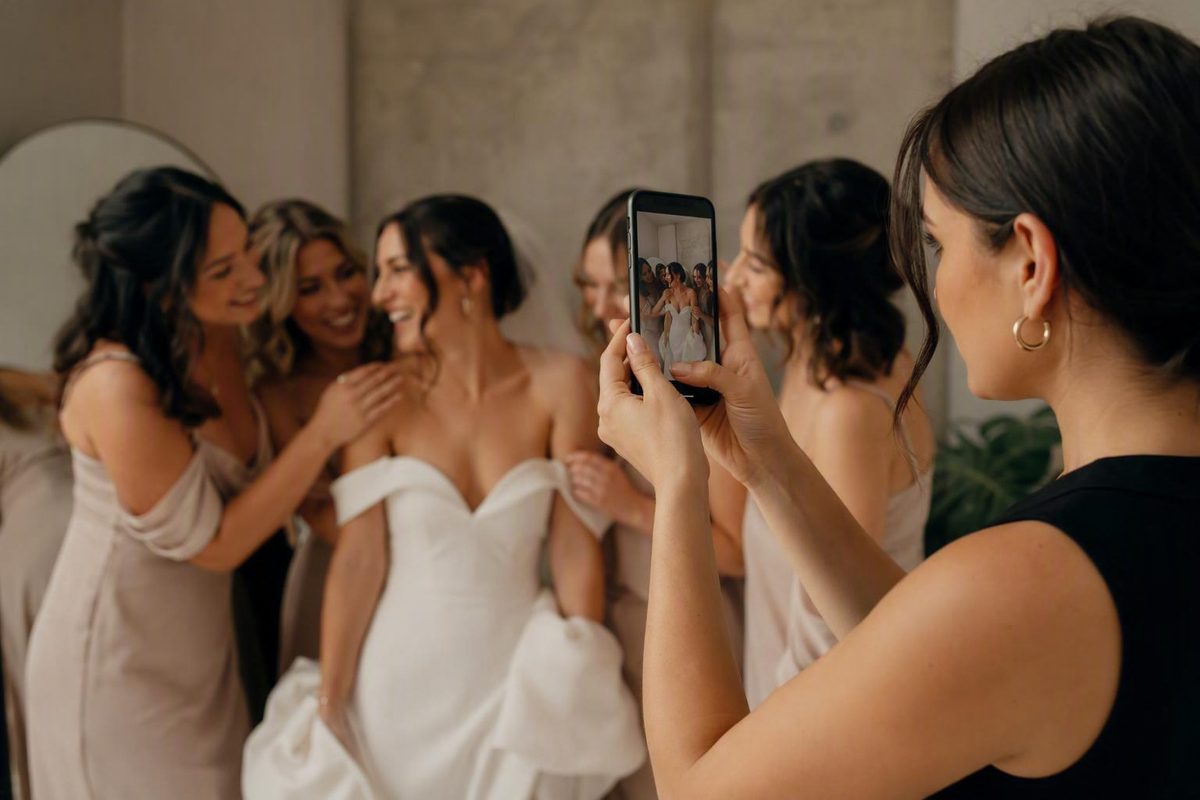
Common outputs include candid clips, vertical edits and rapid delivery; compare audio, turnaround, posting rights, backups and retention before booking.
A wedding content creator typically captures candid, behind-the-scenes photos and short videos for quick private viewing or social-media use. Smartphone filming, vertical framing, and delivery within a day or two are common, but the job title guarantees none of them. Before booking, define the files, edits, audio, turnaround, posting permissions, usage rights, backup process, and retention period you are actually buying.
Related: Best Video Editing Apps for Social Media Workflows.
The short answer: what a wedding content creator does
Wedding content creation is usually optimized for immediacy. Instead of waiting for a finished gallery or film, the couple receives informal clips they can watch, download, send to family, or post soon after the wedding.
Common deliverables include:
- Candid photos and short video clips
- A curated collection of otherwise unedited footage
- Vertical Instagram Reels or TikToks
- Trend, lip-sync, or transition videos
- Short highlight edits
- Captions or text overlays
- Live posting or a temporary social-account takeover
- Optional recordings of speeches, dances, vows, or surprises
Phone capture and vertical video are common, but neither defines every provider. Some creators use cameras, microphones, lights, gimbals, or drones. Some deliver files the following morning; others need several days. The scope depends on the provider and package.
The role usually supplements professional photography and videography rather than automatically replacing either one. Photographers can capture candid moments, and videographers can offer vertical previews. The meaningful difference is the contracted output, not exclusive ownership of a particular style.
Quick decision guide
- Hire a wedding content creator when fast, informal footage and short social-ready edits are priorities.
- Prioritize a photographer when polished stills, prints, albums, and carefully edited portraits matter most.
- Prioritize a videographer when you want complete ceremonies or speeches, dedicated audio, multicamera coverage, or a polished long-form film.
- Consider more than one service when you want both rapid phone-native footage and finished photography or filmmaking.
Public posting is optional. You can request rapid private delivery while prohibiting live posts, account access, vendor previews, and later portfolio use.
What the deliverables can—and cannot—include
“Wedding content” is not a standardized product. Break each proposal into four categories before comparing it.
1. Source files
These may include candid photos and video clips captured throughout the day. Ask about resolution, orientation, audio, organization, culling, filenames, and timestamps.
Be careful with the phrase raw footage. It can mean every file recorded, but it may instead mean a selected gallery that has not been trimmed, color-corrected, stabilized, or otherwise edited. One provider, for example, says it removes duplicates, blurry images, unsuitable dialogue, and unusable clips before delivering what it calls an unedited gallery (Plan With Laur’s delivery workflow).
The agreement should define one of these:
- Every captured file, including accidental, duplicate, and unusable material; or
- A curated, otherwise unedited set, with permission to remove specified categories of files.
2. Edited short videos
These can include a recap, getting-ready montage, transition, trend recreation, guest-reaction edit, or another short vertical video. Confirm the exact number, approximate duration, orientation, caption treatment, music responsibility, revision allowance, and delivery date.
“One edited Reel” is more precise than “social content,” but it still leaves questions. Is it 15 seconds or two minutes? Are subtitles included? Can you request changes? Will you receive a clean version without music, text, or platform graphics?
3. Full-event clips
Some creators record complete vows, speeches, dances, or surprises. Never assume those recordings are included in a package promising only short-form footage. Continuous coverage requires the creator to remain in position, maintain power and storage, and capture usable audio throughout the event.
Ask separately about:
- The complete ceremony and vows
- Every speech or toast
- First dances
- Cultural or religious events
- Planned surprises
- Continuous versus interrupted recording
4. Posting and social management
Filming and posting are separate services. A creator might deliver files only, prepare captions, publish approved Stories, or manage an account during the wedding. Clarify whether posting will be live, delayed until approval, or prohibited.
Use a worksheet that forces every provider to answer the same questions:
| Comparison field | Package A | Package B | Package C |
|---|---|---|---|
| Coverage and staffing | 6 hours; one creator | 10 hours; one creator | 10 hours; two creators |
| Source files | Curated unedited set | Every usable clip | Not defined |
| Estimated quantity | 150–250 assets | 400–600 assets | No estimate |
| Edited videos | Two, up to 30 sec | Five, up to 60 sec | Three; length unstated |
| Format | Vertical | Vertical and horizontal | Not specified |
| Full-event recordings | None | Speeches only | Ceremony and speeches |
| Captions | None | Burned in | One captioned version |
| Delivery | Files in 48 hours | Files next day; edits in 5 days | “Rapid” only |
| Revisions | One round | Two rounds | Additional fee |
| Posting | None | Scheduled posts | Live takeover |
Do not treat a large file count as proof of meaningful coverage. A smaller, organized collection with clear framing and usable sound may be more valuable than hundreds of repetitive or unidentified files. Consider coverage of priority moments, audio, resolution, organization, and preservation.
Useful folder names include getting ready, ceremony, portraits, cocktail hour, reception, and favorites. Ask whether original filenames and timestamps will remain intact.
Content creator vs photographer vs videographer
The cleanest comparison is based on intended use and workflow—not on who holds which device.
| Criterion | Content creator | Photographer | Videographer |
|---|---|---|---|
| Intended use | Fast viewing and short-form sharing | Polished stills, prints, albums | Edited moving-image record |
| Typical outputs | Candid clips, phone photos, Reels | Edited image gallery and optional album | Highlight film and event edits |
| Framing | Often vertical and phone-native | Still-image compositions | Often horizontal; sometimes mixed |
| Editing depth | Culling and short-form edits | Detailed selection and correction | Sequencing, audio, color, sound |
| Audio approach | Varies; may use device audio | Usually not a core deliverable | Dedicated audio may be included |
| Turnaround | Often rapid | Usually longer than previews | Usually longer except for teasers |
| Long-term use | Informal source material | Finished still archive | Finished audiovisual narrative |
Photography is the specialist choice for polished stills, but candid coverage is not exclusive to content creators. Many photographers document reactions, guest interactions, and unplanned moments alongside formal portraits.
Videography is the stronger fit when the brief requires intelligible vows and speeches, uninterrupted ceremony coverage, multiple camera angles, or a polished long-form film. Those outcomes depend on positioning, audio capture and monitoring, synchronization, editing, and contingency planning—not merely owning a camera or microphone.
Equipment is an unreliable dividing line. Some content creators advertise cameras, drones, wireless microphones, photography, and longer edits, while some videographers offer vertical Reels and rapid previews. Practitioner commentary has documented this increasing overlap while cautioning that equipment alone does not establish production skill (Story of Your Day’s industry analysis).
Format also creates a tradeoff:
- Vertical footage suits current short-form viewing and avoids cropping people into a narrow social frame.
- Horizontal footage suits televisions and widescreen films and may offer more flexibility for some later uses.
- Mixed capture can serve both goals, but it requires deliberate shot planning.
Compare the contracted outputs, skills, and workflow—not the vendor’s title.
How much does wedding content creation cost?
The available evidence does not support one dependable current national or global average. Published figures use different currencies, locations, dates, package structures, and research methods, so combining them into one headline price would be misleading.
| Source and date | Market | Reported example | Limitation |
|---|---|---|---|
| The Knot, 2023 | United States | Packages commonly started around $1,000 (2023 guidance) | Dated estimate, not a national rate survey |
| Baltimore Weddings | Baltimore/DMV | $1,000 for 8 hours unedited; $2,000 for 10 hours plus 5 videos (regional examples) | Named local packages |
| BBC, 2024 | Wales | £400 for 8 hours in one case (BBC report) | One couple and provider |
| Aperture Lane, 2026 | Toronto | Estimated CAD $800–$2,500 (Toronto guide) | Vendor-authored regional estimate |
Zola reports that more than 60% of surveyed couples who hired wedding content creators spent $500–$999. Its broader 2026 survey covered more than 700 recently married couples, but the published page does not provide enough detail about geography, sampling, weighting, or the relevant subgroup to make that range a universal market rate (Zola’s survey summary).
Quotes can vary because of:
- Location and wedding date
- Coverage hours
- One creator versus two
- Number and duration of edits
- Full-event recordings
- Audio or specialist equipment
- Travel and accommodation
- Turnaround deadline
- Revision rounds and overtime
- Live posting or account management
- Usage and promotional rights
Normalize quotes with the same worksheet:
| Cost component | Provider 1 | Provider 2 | Provider 3 |
|---|---|---|---|
| Base coverage and hours | |||
| Source files included | |||
| Number and length of edits | |||
| Second creator | |||
| Travel and accommodation | |||
| Overtime rate | |||
| Revision rounds | |||
| Rush delivery | |||
| Usage rights | |||
| Total price and currency |
A cheaper package may exclude edits, travel, full speeches, revisions, or a second creator. Compare the same scope, geography, currency, and publication date before deciding that one quote is expensive.
Is the service worth it for your wedding?
Decide according to the output you want, not whether you consider yourself active on social media.
| Desired outcome | Fit | What to confirm |
|---|---|---|
| Quickly delivered candid clips | Strong | Deadline and source-file definition |
| Informal guest moments | Strong | Coverage priorities and access |
| Vertical Reels or TikToks | Strong | Count, length, captions, music |
| Trend or transition recreation | Strong | Setup time and planned shots |
| Private next-day phone footage | Strong | No-posting and privacy terms |
| A second angle | Possible | Positioning and interference rules |
| Simultaneous events | Possible | Whether a second creator is included |
| Polished still photographs | Insufficient alone | Hire a photographer |
| Intelligible vows and speeches | Insufficient unless contracted | Audio and recording plan |
| Complete ceremony coverage | Insufficient unless included | Continuous capture and backup |
| Long-form wedding film | Usually insufficient alone | Hire a videographer or verified hybrid |
You do not need to post publicly for the service to be useful. Informal footage can be an accessible private record to watch on a phone, send to family, or revisit while waiting for finished photographs and films.
Limitations are practical. Phone footage can vary in low light, stabilization, and audio quality. Vertical material may be awkward for widescreen viewing. Another vendor can block an angle. “Fast” does not guarantee next-day delivery, and “all the moments” does not establish complete coverage.
Adding another vendor can also create congestion if several people try to direct the couple or occupy the same position. Coordination is part of the working brief.
How to evaluate portfolios and compare providers
A polished Reel proves that a provider can make that Reel. It does not demonstrate consistent coverage across a dark reception, usable speech audio, dependable file handling, or calm collaboration throughout a wedding day.
Use this scorecard:
| Area | What to request | What to assess |
|---|---|---|
| Real-wedding experience | Several complete examples | Timing, anticipation, consistency |
| Source footage | A representative delivered folder | Culling, framing, sound, organization |
| Finished edits | Several edits from one wedding | Style, pacing, stabilization |
| Low-light work | Reception and dance-floor clips | Noise, focus, exposure |
| Speech audio | Unedited and finished examples | Clarity and continuity |
| Collaboration | Work involving other media teams | Positioning and communication |
| Compatibility | Consultation or planning call | Responsiveness, expectations, working style |
| Reliability | Backup and replacement plan | Operational readiness |
| Client experience | Reviews or references | Recurring strengths and problems |
Distinguish real weddings from styled shoots. Styled work can demonstrate taste and composition, but it does not reproduce a live timeline, a crowded aisle, changing light, limited setup time, or an unrepeated first kiss.
Ask to see delivered source footage as well as finished edits. This reveals what happens between capture and delivery: what gets removed, whether sound remains usable, how shaky footage is treated, and whether the gallery is easy to navigate.
Reviews and references can help, but provider-selected testimonials do not establish typical performance. Look for recurring comments about punctuality, communication, delivery, conduct around other vendors, and problem resolution.
Ask operational questions too:
- Is there a backup phone or camera?
- How are power and available storage monitored?
- Is replacement staff available if the creator becomes ill?
- Does the provider carry insurance required by the venue?
- What happens if hotel or venue internet delays uploading?
- What is the agreed response if delivery is late?
- Can one person cover the venue layout and timeline?
- Would simultaneous preparations or reception activity justify a second creator?
No particular device, follower count, award, or portfolio size is sufficient proof of quality. Look for relevant work produced under conditions similar to your wedding, supported by a credible operating plan.
Put the deliverables, rights, and privacy rules in writing
The agreement should specify:
- Wedding date, locations, arrival time, and coverage hours
- Number and identity of creators
- Priority people and moments
- Definition of source or “raw” files
- Guaranteed quantities or clearly labeled estimates
- Number and duration of edited videos
- Resolution and orientation
- Full-event recordings included
- Delivery platform and deadlines
- Captioning and text-overlay requirements
- Revision rounds and additional-edit fees
- Overtime and travel charges
- Payment schedule and retainer terms
- Cancellation and rescheduling terms
- Replacement coverage
- Retention period and download-link expiration
Separate four permissions: live posting, private delivery, later public posting, and account takeover. Approval for one should not be treated as approval for the others.
Identify who may use the footage: the couple, creator, planner, venue, photographer, videographer, and other vendors. Distinguish personal sharing from portfolio, advertising, and other promotional reuse. State whether vendors must request access directly and whether the couple approves each use.
Document private moments and guests who must not be posted. Address minors, preparation areas, personal vows, religious ceremonies, and guests with particular privacy needs.
If account access is offered, require the provider to explain how access will be limited, protected, monitored, and revoked. Do not assume a permanent password is necessary.
The agreement should also assign responsibility for music selection and clearance. A track available inside one platform may not be cleared for every cross-platform, vendor, advertising, or commercial use (wedding content workflow guidance).
Rights, privacy, recording, and cancellation outcomes may depend on the agreement and applicable law. Treat this as a list of questions, not legal advice, and obtain qualified local guidance where necessary.
Plan coordination, backups, and delivery before the wedding
A simple pre-wedding workflow can reduce avoidable conflicts:
- Confirm the timeline, locations, travel time, and access restrictions.
- Identify priority people, details, and unrepeated moments.
- Map trends, lip-syncs, or transitions requiring setup shots.
- Introduce the creator to the planner, photographer, and videographer.
- Assign positions for the ceremony entrance, first kiss, speeches, and first dance.
- Confirm posting permissions and private moments.
- Review delivery, backup, and retention arrangements.
The photographer or videographer should receive agreed priority where a contracted shot or audio setup requires a clear position. This does not make the content creator unimportant; it stops multiple vendors from blocking one another during moments that cannot be repeated.
A second creator can help when events happen simultaneously. One person might remain with the couple during portraits while another records guests at cocktail hour. Whether that is worthwhile depends on the venue, schedule, and brief.
Transitions also need timeline space. A clothing-change reveal may require a matching shot before getting dressed and another hours later. If the first shot is missing, the effect may not be recoverable at the reception.
File safety should be equally deliberate:
- Verify at least two copies before deleting or reusing original media, and keep an offsite copy where practical (workflow guidance).
- Confirm that copied files open correctly before starting teaser edits.
- Organize delivery folders consistently.
- Do not clear a phone or card merely because an upload appears complete.
- Record the delivery link’s expiration date.
- State how long the provider retains backup copies.
- Identify when the couple becomes responsible for long-term storage.
Choose the output before choosing the title on the vendor’s website. If a provider cannot define the deliverables, deadline, rights, coordination plan, and backup process, the package is not ready to compare on price.